
If you owe more on your home than it’s worth and can’t keep up with mortgage payments, a short sale may let you sell the property and walk away without a foreclosure on your record — but only if it’s negotiated correctly. Lauren Jackson Law represents homeowners throughout Northern Illinois — including Kane, DuPage, Cook, and McHenry Counties — through every stage of the short sale process as part of our real estate legal services, from our offices in St. Charles and Elgin.
What is a Real Estate Short Sale?
A short sale happens when your mortgage lender agrees to let you sell your home for less than what you owe, and accepts the sale proceeds in exchange for releasing the mortgage lien. It’s typically used as an alternative to foreclosure when a homeowner is facing financial hardship — job loss, medical debt, divorce, or a payment that’s become unaffordable.
Before approving a short sale, your lender will scrutinize your financial situation closely. Expect to provide bank statements, tax returns, pay stubs, and a hardship letter explaining why you can no longer afford the mortgage. The lender wants to confirm that a short sale, not foreclosure, is genuinely the best outcome for them.
How We Help With Your Short Sale
We work directly with your lender, your real estate agent, the buyer’s side, and the title company to keep the transaction moving and to protect you at every step — not just at closing. Before you sign anything with your lender or your listing agent, talk to us first.
Ready to get started? Call us at 847-714-2866, or contact us online.
Our Short Sales Services Include:
- Reviewing your listing agreement and purchase contract
- Coordinating with your mortgage loan officer or loss mitigation team
- Negotiating directly with the lender and other parties
- Working to help you avoid foreclosure
- Securing a written deficiency judgment waiver whenever possible
- Confirming you’re released from personal liability on the debt
- Advising on asset protection
- Drafting and reviewing all required short sale documents
- Explaining every document before you sign it
- Attending your closing with you
Is a Short Sale Right for You?
A short sale may make sense if:
- You owe more on your mortgage than your home would sell for.
- You’re behind on payments, or soon will be, because of a real financial hardship.
- You can’t realistically afford to keep the home, even with a loan modification.
- You want more control over the sale than a foreclosure allows.
A short sale isn’t the right fit for everyone. If you want to keep your home, a loan modification or repayment plan may be worth exploring first. We can talk through your options before you commit to a path.
The Illinois Short Sale Process, Step by Step
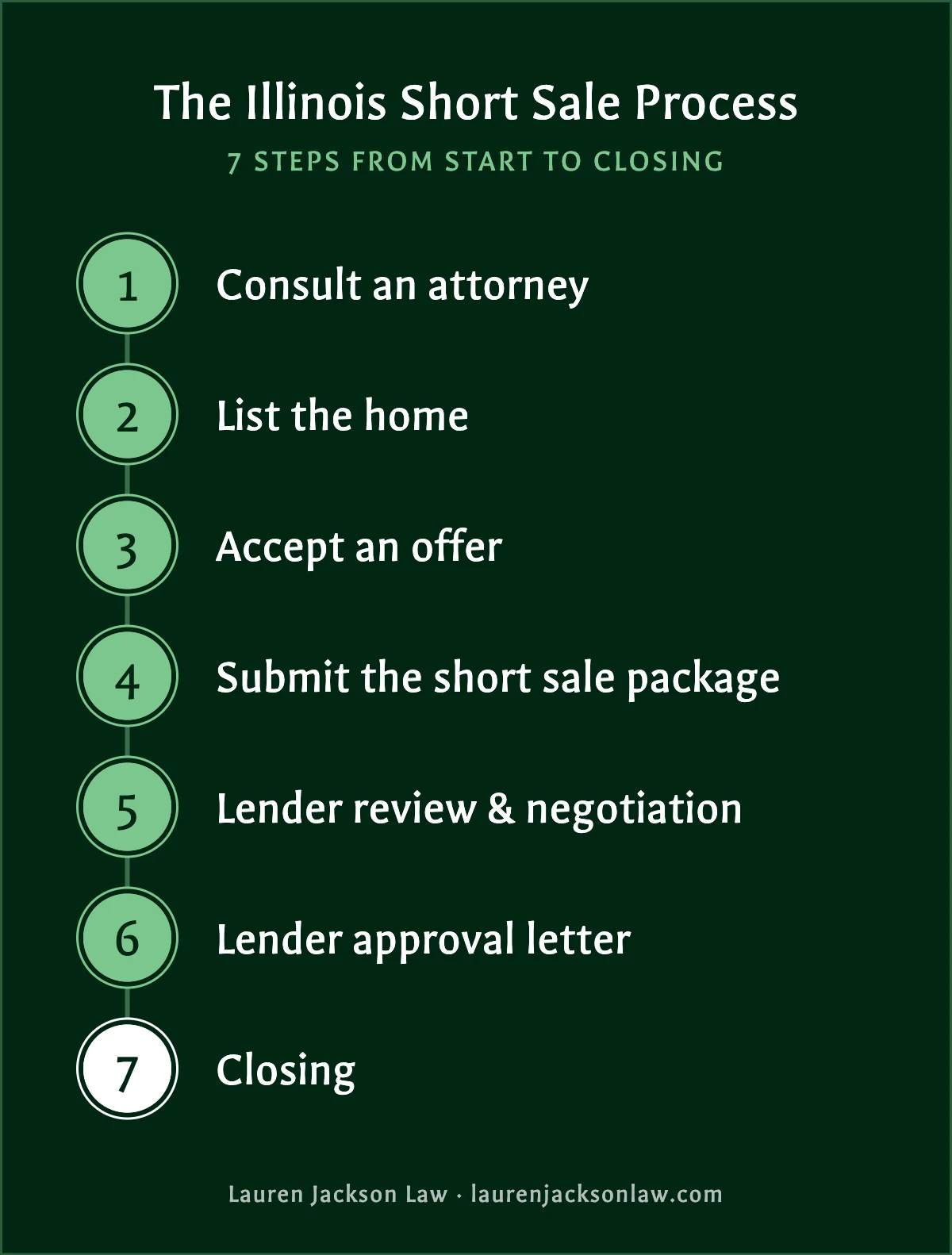
- Consult an attorney first. Before you sign a listing agreement or anything from your lender, we review your situation and the documents.
- List the home. Your real estate agent markets the property, usually noting that the sale is subject to lender approval.
- Accept an offer. You sign a purchase contract with a buyer, conditioned on the lender approving the sale.
- Submit the short sale package. This includes the contract, your hardship letter, and financial documents such as bank statements, tax returns, and pay stubs.
- Lender review and negotiation. The lender orders a valuation, reviews the file, and may counter. If there’s a second mortgage or other lien, those lenders must agree too.
- Approval letter. We review the lender’s approval letter carefully, especially the language about any remaining balance (the deficiency).
- Closing. We attend closing with you and confirm the documents match what the lender approved.
Buying a short sale property? We also represent buyers through the purchase process.
Short Sale vs. Foreclosure vs. Loan Modification
| Short Sale | Foreclosure | Loan Modification | |
|---|---|---|---|
| Do you keep the home? | No | No | Yes |
| Who controls the sale? | You and your agent, with lender approval | The lender and the court | No sale |
| Remaining balance | Can be waived in writing | Lender may seek a deficiency judgment | Loan stays in place |
| Credit impact | Negative, generally less severe than foreclosure | Most severe | Depends on how it’s reported |
| Typical timeline | Often 60–120 days after an accepted offer | Often many months through the court process | Varies by lender |
Second Mortgages, HOA Dues, and Other Liens
If your home has a second mortgage, a home equity line of credit, unpaid HOA dues, or a judgment lien, each of those must be resolved before closing. Junior lienholders often ask for a payment in exchange for releasing their lien, and the first mortgage lender usually limits how much it will allow. We negotiate with each party so the sale can close, and we look for language releasing you from those debts too.
Flat-Fee Short Sale Representation
We handle short sales for a flat fee, so you know the cost of our legal work up front, without hourly billing surprises while the lender reviews your file. Call 847-714-2866 to schedule a consultation and discuss your situation, or read what past clients say about working with us.
Short Sale FAQs
How long does a short sale take to close?
Most Illinois short sales take 60–120 days from accepted offer to closing, depending on how quickly the lender reviews and approves the sale price. Complex files or second mortgages can take longer.
What's the difference between a short sale and a deed in lieu of foreclosure?
In a short sale, you sell the home to a buyer at a lender-approved price. In a deed in lieu, you transfer the property directly to the lender instead of selling it. Short sales usually take longer but give you more control over the sale price and terms.
Will a short sale hurt my credit as much as a foreclosure?
Both will lower your credit score, but a short sale is generally viewed as less severe than a foreclosure and often allows you to qualify for a new mortgage sooner. The exact impact depends on your overall credit history and how the account is reported by your lender.
Is the debt forgiven in a short sale taxable income?
It can be. When a lender forgives part of what you owe, it usually reports the forgiven amount to the IRS on Form 1099-C, and that amount may count as taxable income. Exceptions can apply, such as insolvency, so speak with a CPA or tax attorney about your specific situation before closing.
Do I need a lawyer for a short sale in Illinois?
You’re not legally required to hire an attorney for a short sale, but Illinois allows lenders to pursue a deficiency judgment unless your agreement waives that right in writing. An attorney reviews and negotiates that language before you sign — something a real estate agent isn’t licensed to do.
Reviewed by Lauren E. Jackson, Attorney at Law · Updated October 2026
Contact Us Today
Ready to get started?
Call us at 847-714-2866